Friday, 8 February 2013

Portobello - Forts, Forts and more Forts

Portobello is famous for many reasons.  The bay was discovered by Christopher Columbus in 1502, is believed to be the final resting place of Sir Frances Drake after he died of dysentery at sea, and for three centuries was one of the (if not the) main transhipment centres in the Caribbean, transferring South and Central American riches back to Europe.  The customs house at Portobello, built in 1630, was the place where the riches were counted and royal fees paid.  For a century, a third of all the gold in the world passed through this spot.

(Read more: http://www.frommers.com/destinations/portobelo/3755010029.html#ixzz2KLGJHPfZ)


In 1980 the ruins of the Spanish colonial fortifications and Fort San Lorenzo were declared a USESCO world heritage site.


We arrive in Portobello after a night’s stop over in Isla Linton.  The bay is packed with cruisers and we pick out a few that we know.   One of these is Blue Kai, a large Catamaran with Mum, Dad and two kids on board.  We have been meeting up with Blue Kai since Dominica, nearly a year ago.  We head over and get the low down on the place. 

We tie up at the cruiser’s dinghy dock at the centre of town, after being told to avoid the public dinghy dock that is rumoured to be unsafe. All the cruiser dinghies are here, but it sure doesn’t look like the ideal place to leave your dinghy.

The "safe" Dinghy Dock at Portobello

At the end of the dinghy dock alley, we arrive right in the middle of town, by the famous Customs House.  The roads are cobbled stones and the buildings old and in Spanish style.  Stray dogs roam the streets, and people are sitting on the pavement, leaning up against the side of buildings.  It is our first real taste of a Spanish town, and we greet the passers-by with “Buenos Dias” or “Hola”. 


Despite being very poor, the locals can still afford satellite TV
We visit the Church where the statute of the Black Christ of Portobello reins.  Every October 21 there is a festival for the Black Christ of Portobello and people walk on their knees from as far as Costa Rica to pay their respects.  We wander through the tall wooden doors of the Church.  Inside, a girl is singing in the corner as her brother plays along on his guitar.  At the left hand side of the pulpit, we see the life size statue, encased in a glass viewing box, wearing a purple velveteen robe and carrying a gold painted cross.   On the wall beside us I notice a smaller statue of the Black Christ hanging from the cross, his right side having a large gash and exposing his rib bones.  Below this I am surprised to see another life size statute encased in a glass box.  This time the Black Christ is horizontal, seemingly in a coffin, with his hands crossed over his chest and his eyes closed.  We don’t feel right taking any pictures inside.


Back out in the street, we make our way up the hill to Captain Jack’s bar to send off a few emails. 

Panama Bus 
The next day, we hear Blue Kai on the radio arranging a day out for the “Kid Boats”.  There are an extraordinary amount of boats with kids on board in this bay.  Six boats or more respond and a trip up the river is planned.  We consider attempting to get on the bandwagon; surely we still count as kids, right?  We peek out the window when the rendezvous time arrives and decide that the age limit is 12, so give it a miss.

Once all the kids have exited the river and made their way home, we make a trip up the river ourselves.  The river is lined with tropical plants, many of which I recognise having planted our front garden in New Zealand with them.  We see a few birds and fish and enjoy the “land smell” around the river.  


The following day is dedicated to forts, of which there are many in Portobello.  We begin with the fort closest to the boat, on the southern side of the bay.  By the time we have explored and made it to the top of the hill, the Kid Boats arrive.  A swarm of small people run up the hill at triple the pace we had managed.  Once atop the hill they giggle, point and run around, none of them seemingly out of breath.  They look down the “bottomless pit” and balance along the high fort wall with sheer drop on one side, arms out to the side and completing the odd jump like a gymnast. 

On our way back down the hill we meet up with the parents who are still attempting the uphill climb.  We chat and swap information – many of them are heading across the pacific at the same time as us.  We cross the fort at the bottom of the hill and head back towards the dinghies.  One of the Dad’s leads us a different way than what we had taken, which includes a walk over a rotten looking plank between the two sides of the moat. I hesitate, looking down at the three-metre drop.  The Dad is still merrily continuing his conversation with us as he strides across the plank.  He turns around and sees I haven’t followed.  In true Dad style, he holds out his hands towards me and tells me to look at him and not look down.  I follow his advice and manage it safely across.  I breathe a sigh of relief, only to be gobsmacked by a 5 year old child happily skipping across the same plank, followed by an older child managing to jump the distance without the use of the plank at all.  I’m getting old.

We visit another three forts that day, one up an extremely steep hill.  Luckily there were no kids around to show me up this time.


Not even half way up


That night, our last in Portobello, we head back up the river just before sun set to try our luck fishing.  We had heard it was like shooting fish in a barrel.  We end up empty handed and blame it on our fishing lures, which are designed for trawling and not for river fishing.  I hear what I think is a pack of wild dogs howling as the sun goes down.  It's really loud and aggressive, and there are heaps of them out there.  I find out later that it wasn't dogs, but monkeys making the noise. I forget bug repellant and am eaten alive by no-see-ums.  Gary counts 29 bites on one thigh alone.   Itchy and hungry, we head back to the boat.


Thursday, 7 February 2013

The San Blas Islands

The San Blas Islands (Kuna Yala) are made up of many groups of picture perfect tropical islands.  Gary thinks that this is where all tropical island postcard pictures are taken, and he might just be right. 

We begin our time in the San Blas at the Holandes Cays, and island hop every couple of days.   

BBQ Island (AKA Turtle Island), Holandes Cays

Kuna huts on Tiaup Island, Holandes Cays


Olosicuidup Island, Coco Bandero Cays


Wreck of a cargo ship off the Coco Bandero Cays
The San Blas Islands are home to the indigenous Kuna Indians who shun western culture and generally continue to live their traditional tribal lifestyle.  While they accept visitors, there are certain rules that must be followed.  You must not be ashore after dark and must never take a coconut, as every coconut in the San Blas has an owner.  Nudity is frowned upon, as is wearing only your bikini in the villages of inhabited islands.  

We are intrigued at the Kuna huts, made from cane and palm tree fronds.  We see a dug out canoe ("ulu") arrive at one of the islands late in the afternoon, weighed down to the gunnel with provisions from the mainland.   There are a few unusual items on the canoe - three brand new solar panels.  That night we notice the glow of lights in the huts, that we assume must be powered by solar panels as we see (and hear) no generators.

Banedup Island, Eastern Lemmon Cays
Nuinudup Island, Eastern Lemmon Cays

Banedup Island, Eastern Lemmon Cays

Uchutupu Pipigua, Chichime Cays

Uchutupu Pipigua, Chichime Cays

Uchutupu Dummat Island, Chichime Cays

Uchutupu Pipigua, Chichime Cays

Chichime Cays
We are approached most days by the Kuna men, selling fish, lobster and crabs.  We avoid the fish, which are generally pretty reef fish, but can't resist the lobster.  We manage to communicate with the Kuna with our little knowledge of Spanish, and lots of hand gestures.  While reasonably priced, at $5-$10US each, the lobsters are quite small, only the largest being of legal size in New Zealand.  The first time we buy a couple of lobster, the Kuna man does not have change, so gives us an extra lobster instead.  Feeling sorry for this baby lobster, we wait until the Kuna are out of sight, then set him free of the back of the boat.

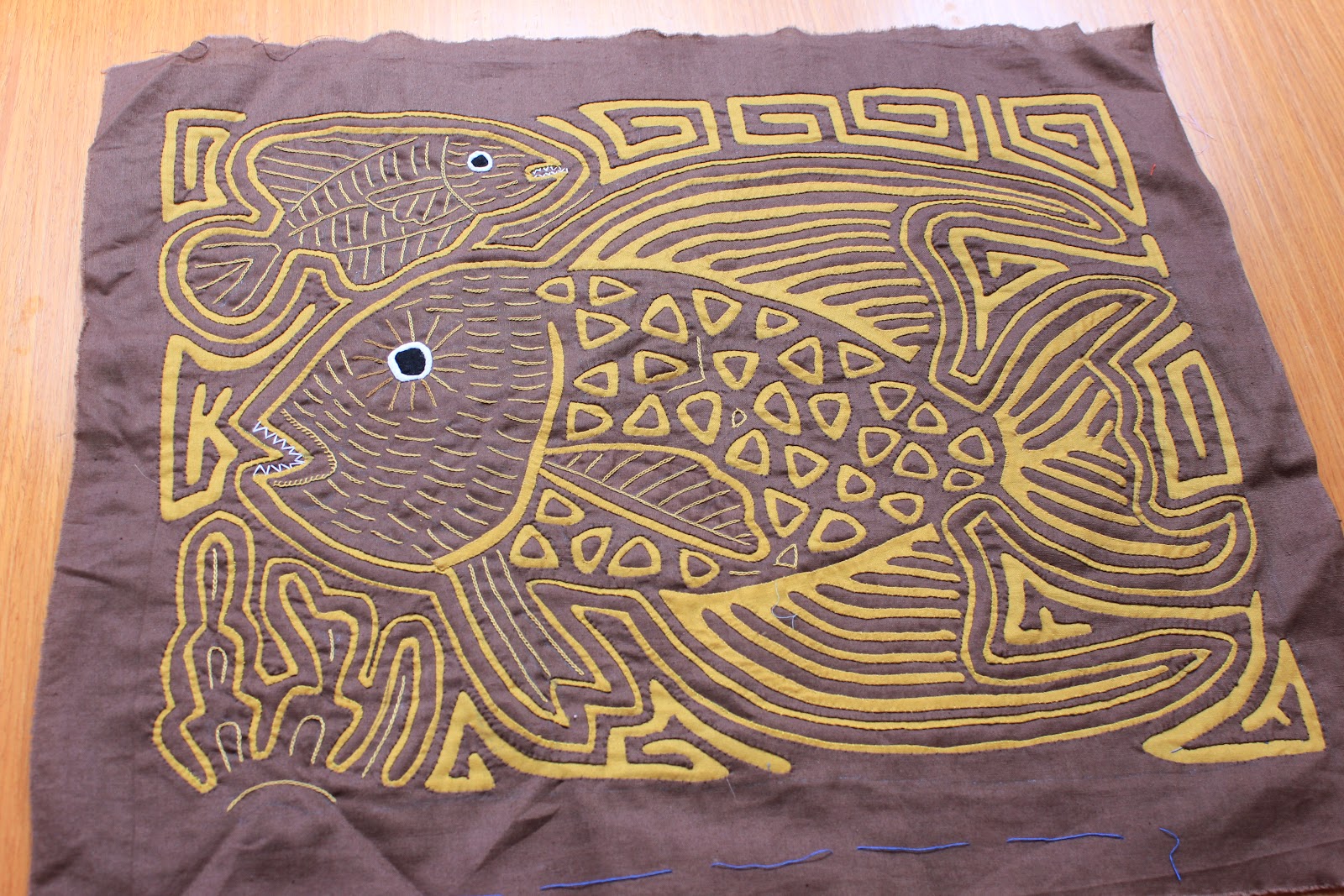
The Kuna women also make frequent visits to our boat selling Mola.  The Mola are a square of textile that are completely handmade, having multiple layers of different coloured cloth with the patterns cut out to expose different layers then sewn together with intricate stitches.  Each island we go to, we are approached by a women with literally hundreds of Mola to choose from.  They are very persistent and will not take no for an answer.  We look through their Mola diligently, and buy one or two from each woman.  We are now fully stocked with 6 Mola.   


After each exchange of fish or Mola, whether we buy something or not, we are always asked (in Spanish) for sweets or chocolate.  After being asked many times, we come to recognise the words.  Unfortunately, we have none on board so have to then attempt to communicate this to them.  

Gary spends most of his days free diving on the reefs, trying to find his own lobster.  He finds many, but nothing big enough to make him feel comfortable taking.  Where the coral is particularly good, Gary comes back and picks me up to explore with him.  We are told there are many sharks around, but they are not aggressive.  Despite this "non aggressive" proviso, I still hold on to Gary's hand tight.  I keep a good look out over my shoulder but don't see any sharks.  I am relieved, but Gary is disappointed. 

After a quiet week recovering from our trip across the Caribbean sea, walking on white sand beaches, snorkelling and eating lobster, we head to Portobello.

Sunday, 3 February 2013

Crossing the Caribbean Sea

We wake up before the sun at Village Cay Marina, Tortola.  After a quick breakfast and last minute preparations, we cast off our lines and head out of the marina just as the sun begins to peek over the horizon.  As we enter Sir Frances Drake Channel there is only a light 15 knot breeze and the sea is completely flat.  In another hour, we cross behind Norman Island and head out to sea towards Panama and the ocean swell sets in.

As the BVI disappears into the distance, we take a few quick pictures.


In the afternoon we can see Puerto Rico far in the distance to starboard, and the US Virgin Island of St Croix off to port.  As night falls, we can still just make out St Croix and this is the last land we will see for another 5 days. 

One day melts into the next with 4hour watches during the day, followed by 3hour watches at night.  We don't have to change the sails much over the first three days, with pretty consistent   winds up to about 20knots.  We set a more southerly route for this section, to take advantage of the stronger easterly winds in the lower Caribbean.  

As we approach the Colombian coast on Day 3, the winds are picking up and the sea is building.  We have a fun afternoon surfing down steep 4 metre waves, regularly hitting 12 knots, the occasional burst to 14 knots and reaching a top speed of 15.3 knots.  This was not so much fun in the dark, and although Toodles was handling it well, we decided to be cautious and reduced sail to slow the boat down to "only" 8 knots.  As the night wore on, and morning arrived, the sea continued to worsen. There were three different sets of swells by Day 4, and the odd quartering 6 metre wave.  We reduced sail further to maintain proper control.  By late afternoon we were through the worst of it. 

One of the strangest things I found with ocean sailing was the sound of the ocean surf.  While stressed out during exam times at uni, I would play an Ocean Surf CD during the night to help me relax.  I always thought this sound was of waves breaking on a surf beach, but I think I was wrong.  We slept on deck every night, and when I would wake up I would have that strange sensation of trying to work out where the heck I was.  The sound of the waves breaking all around us was so loud, that I could imagine that I had fallen asleep on a very active surf beach.  I don't think that the Ocean Surf CD will be any use in helping me relax any more - it will just take me back to the Colombian coast.

Another thing I wasn't expecting was how cold it would get at night.  We both slept with two blankets and still felt the cold when the winds blew, cutting straight through them.  Although this was contrasted with the mornings when the sun would stream into the cockpit with no where to hide.  I would quickly go from being too cold to being way too hot, throwing off as much clothing as possible.  

Wearing a harness 24/7 is also up there on the uncomfortable-ness scale.  When you are exhausted, covered in salt, and thinking you might be suffering from mild exposure, the harness feels heavy and cumbersome.  It chafes your neck during the day, and makes it impossible to get comfortable when putting your head down on a pillow at night.  And ours are the top of the range awesome ones, so this is as comfortable as they get.

By the morning of Day 5, we knew that we would make it to the San Blas by nightfall.  The pressure was on, but the wind didn't get the memo.  After having blasting winds of 25-35knots for the last 24 hours, it fell away to next to nothing.  To make matters worse, a counter current  set in.  So on went the engine to make sure that we could make it in time.  We needed to make it as close midday as possible so that the sun was overhead and the reefs most visible.  Like the pacific, charts of the San Blas Islands are notoriously inaccurate.  Your chart plotter may say that you are in the middle of the channel, when you are actually aground on a reef.  Throughout the San Blas islands are wrecks of yachts and ships that can attest to this.  

The last 4 hours of the crossing were some of the hardest.  The minutes dragged like hours and we still couldn't see land.  Only about an hour out could we make out the low lying San Blas Islands, and in particular the Holandes group of islands we were heading for.  At this stage we realised that what we thought was dark clouds in the distance, was actually the central american coast line in mist and haze.  

We made it through the fringing reef at about 3pm, just in time for the reefs to still be visible.  We pulled in to the most amazing group of small islands with complete shelter due to the fringing reef.  For the first time in 5 1/2 days the boat was stopped, the crashing waves sounded distant, and the absence of engine noise was deafening.  The very first thing on my priority list (other than call my Dad of course) was to wash off the salt and attempt to turn the mat of tangled mess on my head back into hair.  With that completed, and a rum and coke in hand, we took in the view...


Friday, 25 January 2013

Almost back to civilisation

We are still alive!

The San Blas islands were beautiful, and I will do a proper blog with photos when we can.

Being in a group of deserted islands has its perks, but internet is not one of them.  Our computer also died (not an Apple problem, you apple haters!)  and we are  hoping to take it to the doctor when we reach Colon in a week.

We are currently in the town of Portobello, and for the first time on a continent and not an island.  We are enjoying the sights, sounds and smells of Central America, but again I will give you a proper blog on that when we are back up and running again.

But for the moment I will leave you with the view from the bar we are currently sitting in.


Wednesday, 16 January 2013

Satphone report Wednesday 16/1/13

1500 hrs
ARRIVED Hollandaise Keys, San Blas Islands, Panama!
Toodles is anchored in perfect calm water just off an idyllic island covered in palm trees,  Katie and Gary are jubilant,  weary, hungry windblown and in need of a good wash and change of clothes!
Another rough night last night, then the wind eased this morning and motor sailed the last bit.  Only saw land an hour or two out - low lying land and misty cloud.  Toodles was great on the trip, best daily run well over 200 miles (217?), took rough seas in her stride.  Total trip time for 1000 miles 5 days 9 hours - a really fast trip.   The freezer stopped working on the first day, so Katies carefully prepared frozen meals were wasted,  but Gary can get onto fixing that tomorrow.  Meanwhile they are both looking forward to a swim, a shower, and a rum!
Well done!

Posted by Andrew.

Tuesday, 15 January 2013

Satphone report Tuesday 15/1/13 1400hrs

Position: 11*42.1'N
                76*15.6'W
Course 238* at 9 knots
Wind NE 21
Sea moderating

Last night was very rough as they turned the corner of Columbia - wind 30 knots, steep confused 4M seas from two directions converging, but a fast night and a good daily run (over 200 miles?).   Katie and Gary are in high spirits, both looking forward to last night at sea tonight and hopefully arrival tomorrow before dark - they will reschedule the satphone report on arrival about 11am NZ time, so blog will be updated later than usual.
Forecast is for 20 knots through tonight, wind easing to 15 and then to 10 as they approach the coast.

Posted by Andrew.

Monday, 14 January 2013

Daily Satphone report - Monday 14/1/13   1400 hrs

Position  13*24.6'N
                72*58.6'W
Course 247 at 9.5 knots
Wind 23 knots E
Boisterous steep short seas

Katie reports great sailing, they have touched 15.3 knots down a wave earlier today, Toodles is feeling more comfortable to be aboard sailing steady and fast with more wind despite increasing seas.  Last night Gary reefed the main in the night when the wind came up, tonight they plan to reef before nightfall, though this may depend on progress - looks like they might make the earliest of the san Blas islands before sunset day after tomorrow if they keep up a good speed - 415 miles to go to that point.
Half way point was reached in the early hours of this morning and katie celebrated with a good sleep - she was sick again in the night, but feels great today.
Forecast is for 20 knots, increasing to 25 early tomorrow morning.  Gary is considering a gybe to clear further off the columbian coast (the wind is greater and the seas steeper near the coast, and they have come closer to that coast than intended), but he will see how it looks later in the day.

Posted by Andrew.