Sunday, 24 February 2013

Panama Canal Day 2

The next advisor was due to arrive at 6am and we set the alarm for 5.45am.  The alarm goes off just as Eric calls that the pilot boat with the advisor has just arrived.  Throwing on clothes and brushing teeth, we make an appearance as quickly as possible.  I make scrambled eggs for the crew, with Pepe on toast, as we cross Gatun Lake.

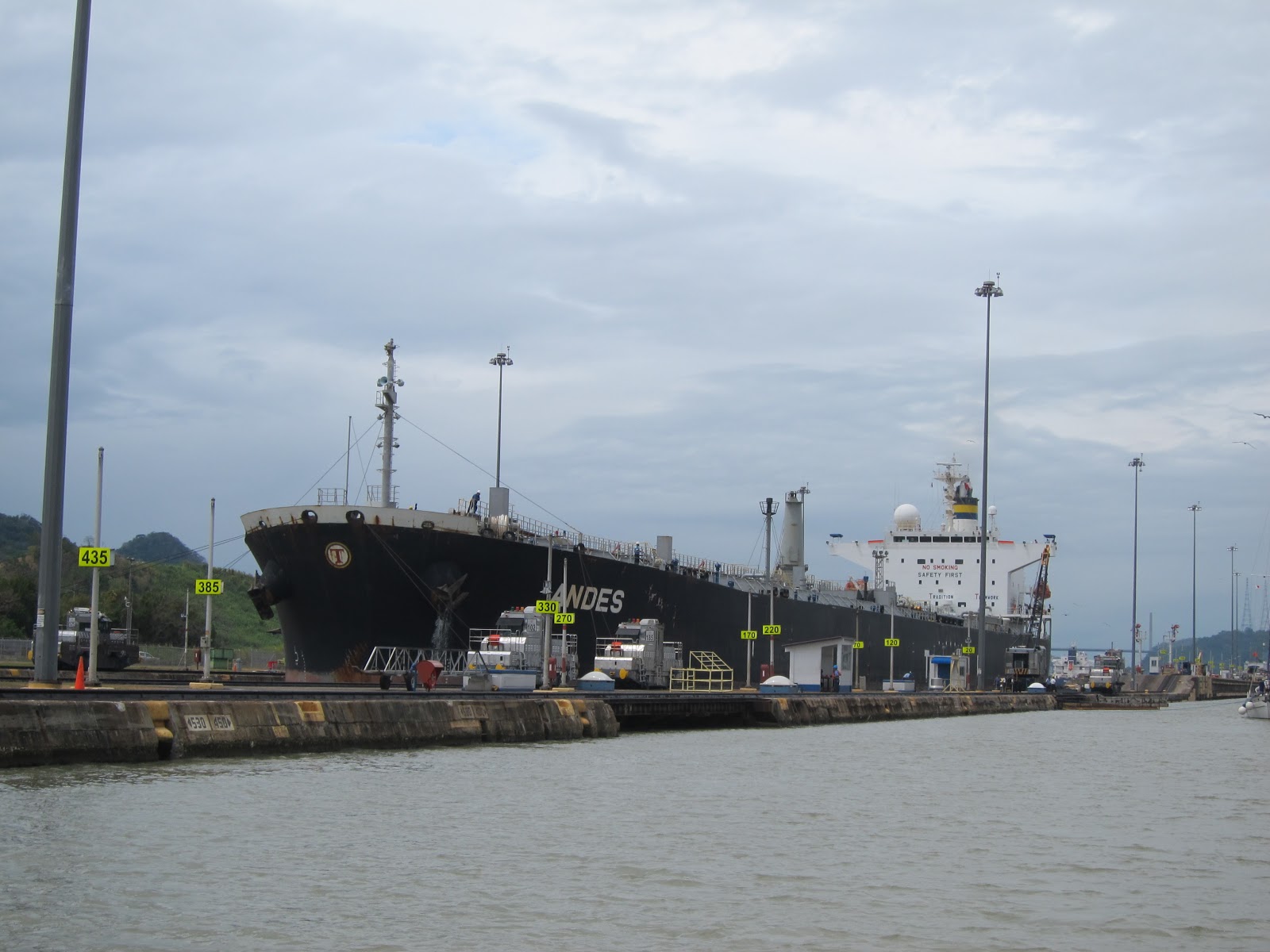
Gobbling up breakfast on deck, we watch the big cargo ships pass close by.  To make the canal, the Chagres River was dammed and the area flooded to form the lake.  We pass little islands that are in fact the tops of the mountains that once stood above the river.  We also spot the tops of trees that poke up from the forest floor that is now the lake bed. Very strange.  


We find out the yacht that had been on the other side of the raft, but we hadn't seen past the huge African Queen, is another New Zealand boat called Waka Irie.  To keep up speed, they hoist the sails and sail across the lake - an awesome sight.


Our new advisor works in the visitors centre and is a wealth of knowledge on the canal.  Work on the canal started in 1881 and finished in 1914.  The first attempt to build a canal was by the French who attempted to construct a sea level canal with no locks.  Ferdinand de Lesseps, the builder of the Suez Canal, headed this campaign.  After loosing 22,000 lives from accidents, malaria and yellow fever and US$287,000,000, the French abandoned the effort in 1893.  

In 1904, the US, under President Roosevelt, bought the French equipment, excavations and the Panama Railway for US$40 million.  The US also paid the new country of Panama US$10 million plus a yearly fee, as well as Colombia US$10million plus US$250,000 p.a. for 7 years so that Colombia would recognise Panama as a new nation state.  The US effort excavated a further 130,000,000 square metres (on top of the French 23,000,000 square metres), and lost another 5,600 lives to construct the canal - now with a locks system rather than a sea level canal.

Eric and our Advisor
The Culebra Cut section of the canal was the most challenging part of building the canal. As we approach the cut, we consider the lives lost.

Approaching Centennial Bridge in the Culebra Cut

Culebra Cut


Centennial Bridge


Dee and Eric enjoying a quiet moment


Today has two sets of locks in store for us.  We reach the first set, the Pedro Miguel Locks, by 11am and raft again with African Queen.  

Waka Irie preparing to raft
As we approach the lock we see a crocodile surface.  We aren't quick enough to get a full picture of him, but we do capture him as he sinks back below the surface.


Everything goes smoothly through the locks, and we wave at some passersby watching the excitement from the roadside on the other side of the fence.   We eat lunch as we transit through the locks - that's got to be one of the strangest picnic locations!  

Pepe our personal photographer and nerve calmer


Still rafted, we motor to the Miraflores locks, our final hurdle before the Pacific.  


line handler throwing the lines


Going down

Line handles walking the lines to the next lock

Practice target for the line handlers

In the final lock, before the gates open, we discuss at what point we are technically in the Pacific.  Some say it is on the other side of the gates, others when you pass under the Bridge of the Americas.  We decide that the other side of the gates is good enough for us.  As the final gates open and we pass the threshold into the salt water of the Pacific, we let out a big cheer and have hugs all round.


Leaving the final lock


As we head towards the Bridge of the Americas we blast the stereo loud with Men at Work "Land Down Under", Gary and I sing at the top of our lungs, followed by the New Zealand band the Black Seeds.  

Heading towards the bridge of the Americas
Looking across at the Panama City skyline
US Military Vessel - With that name, we had to take a picture
Our advisor lets us keep the daily schedule of the canal as a token of our transit.


A pilot boat approaches as we pass under the Bridge of the Americas to pick up our advisor.  Then it is on to Balboa Yacht Club where another boat approaches to pick up our lines and tires as well as our line handlers, to take them ashore.  We head on to La Playita anchorage, drop anchor and have just a few celebratory drinks.  

We are now in the Pacific Ocean.  Home is just over the horizon.

Note:  Huge thank you to Aisha, who provided us with the aerial photos of Toodles in the locks.  Aisha turned out to be the girl who we waved to on the other side of the fence at the Pedro Miguel locks.  After seeing us, she headed up to the visitors centre and took some pictures of Toodles in the Miraflores locks.  I am hugely thankful to this wonderful lady who went to the effort of seeking us out to provide us with the photos.

Saturday, 23 February 2013

Panama Canal Day 1

With laundry and provisioning to do, parts to be ordered and line handlers to find, we were already frazzled by 9am Saturday morning.  By this time, I had already pestered the Shelter Bay Marina office for the use of their land line to call a taxi, been given a cell phone, been refused by two taxi providers, found one to take us, but the cell phone kept on dropping out making communication near impossible, on top of my pigeon spanish and his pigeon english proving seriously prohibitive.  But I had a taxi coming to pick us up and a time secured.  Hurrah!  

Next step, line handlers.  After being referred by two other boats, we doorstep Beez Neez on Saturday morning begging for some assistance.  We quickly realise we have hit the jackpot.   Pepe is super excited to help, jumps onto the pier and gives me a huge hug.   She offers up husband Bear and then asks friends Dee and Eric to help us.  Dee and Eric are just about to leave for another transit, but agree to help us out on Monday.  For them it would be back to back transits, arriving back Sunday night and leaving again Monday afternoon on Toodles.  Mammoth effort.

Our taxi arrives to take us to the supermarket.  Unfortunately, they think they are taking us all the way to Panama City, an hour journey and $250, rather than the 10 minute drive to the supermarket.  An angry cell phone conversation in Spanish back to the taxi boss ensues as I stand sheepishly next to the taxi van thinking perhaps my Spanish wasn't quite as accurate as I thought.  The taxi takes us to our preferred supermarket and we load it up to the windows with food.  We spend the afternoon packing the provisions away before Pepe and Bear arrive for sundowners to check out the boat.  

The next morning's mission is laundry, most importantly the sheets to make up the beds for our lovely line handlers.  Usually I would do it myself, but time being of the essence, I take it to the laundry lady, who for some reason has just failed to turn up that day.  I check back at the laundry every hour, while we service the engine and generator in the meantime, but she still hasn't arrived by mid day.  An office lady has taken up post at the laundry, but she is only taking orders for the following day.  I explain to her that we are leaving the following day and I'll need it by noon.  She appears to understand English completely and reassures me that all will be well.  We spend the rest of the day doing chores, cooking meals for the following day's crossing and other general boat stuff.

Monday arrives, but the laundry doesn't.  I check in again every hour, then half hour as noon approaches.  The new laundry lady does not understand my Spanish or English, and I try to ask whether the bag that still sits unwashed will be ready for mid day.  I have also been attempting to do the laundry myself, but all the machines are full with the laundry lady trying to catch up with the neglected loads from yesterday.  I send Gary to pick up the laundry at 12.30pm.  He arrives back with the laundry, with the exception of two pillowcases never to be seen again, most of it damp and the rest decidedly wet.  I do my best to make up the back cabins with the less damp sheets, hoping the warm air with dry them before bed time.

Our newly recruited line handlers arrive on Toodles - Pepe and Bear from Beez Neez, and Dee and Eric from Sirena of Oare.   

An extra crew member, Bed-z the Teddy Bear, arrives with Pepe and gets prime position by the winches to watch all the excitement.

Bed-z the Teddy Bear
The hugs and good vibes coming from our crew relaxes our nerves.  We wave goodbye to Shelter Bay and are finally on our way.

Leaving the marina
We head out to "the flats" anchorage and wait for our canal advisor.  

One of the boats that waits with us to go through the canal is African Queen, a beautiful multimillion dollar trawler.

"African Queen" the amazing trawler

We chat away and munch on crisps until our advisor arrives at 4.30pm.  We see a pilot boat arrive and deliver an advisor to African Queen and assume we will be the next stop.  Our assumption is wrong.  In true, efficient Panamanian style, each advisor is sent out in their own pilot boat.  

(from left) Dee, Eric and Bear sighting the pilot boat


Our assistant arrives
Once aboard, a discussion between the advisors of the four boats around us begins on the radio.  One of the sailing boats is refusing to raft up.  This means that, instead of the yachts rafting together and the multi-million dollar trawler going alone, the trawler instead has to be the centre of a raft with two yachts  on either side.  I can just imagine the dollar signs spinning in the owner's eyes, thinking of the scratches to his paint work.  

With those instructions in hand, we make the approach towards the canal.

Bear and I, taking in the view

Approaching the first lock

There is a few tense moments when we do raft up, once we are close to the first lock.  Our advisor tells us that we will pass the spring lines (middle lines), and the trawler will pass us the fore and aft lines (front and back).  We approach slowly, Gary at the helm.  We shout to the line handlers on the trawler to pass their lines, but they don't understand (we find out later that they were told we would pass all the lines).  The trawler has some hired local line handlers, in addition to the crew, so there is a wee problem of the language barrier also.

We throw them our spring lines, while they run around and try to find lines to throw. The front line is found quickly.  But our stern begins to drift away, making our "pointy end" drift into them, in a horrible T-boning fashion.   The stern line is still not forthcoming, and there is no one at the stern of the trawler who can help.  Gary "politely" insists that our assistant use the radio in his hand to contact the trawler's assistant and ask for them to send a line handler aft to pass us a line.  But he continues to delay, and doesn't make the phone call.  Our bow is now uncomfortably close to the shiny blue paint of the trawler.  "Get the lines off!" Gary yells, so that we can drift away without hitting.  But our advisor confuses matters by telling our line handlers to hold on and secure the lines.  A few angry words are passed between Gary and the advisor.  Our lines are detached and we drift away without touching.   

Our second attempt is much smoother, with all lines sorted and our "advisor", now no longer speaking to us, not interfering.

Rafting up

Nervously looking at the small gap between us
Now rafted, we head towards the locks.  


The trains or "mules" that pull the cargo ships from either side of the lock


Once inside the lock, we do a final check of the fenders.  Usually the boats closest to each wall takes the lines from shore, but as African Queen is so big, she takes all the lines for the raft.  This means we can sit back and enjoy the show.


The heavy lock doors close, and the lock fills with water.


The current from the water flowing into the lock pushes the raft around, and we readjust the lines.


View from the top of the lock
Moving into lock two
We are told that lock two is where the live canal cameras point towards.  We head to the bow to wave at the cameras, and hopefully to Mum and Dad who are watching.  We make excited phone calls to the parents to check if they can see us.  


Moving on to the final lock, and nearly done for the day, the sun begins to go down.

Line handler ashore throwing lines

Double doors of the final Gatun Lock


We finally reach Gatun Lake of the canal at about 6pm.  We anchor not far off and devour the lasagne I had prepared earlier.  After a few celebratory drinks, we all head to bed for an early night, before a very early morning.

Thursday, 14 February 2013

Lost in Translation

When I went to school in New Zealand, the options of languages were German or French.  Spanish, however, being the most widely spoken language in the world, was not offered.  Before our trip to Panama I don't think I had ever heard a whole sentence of Spanish spoken.  We are now immersed in an entirely Spanish speaking country, where few people speak English.

We are managing to order food quite well, resorting to pointing where necessary.  But for other things it is not so easy.  Explaining to the laundry lady, for instance, that you require your laundry washed and dried, and ready for pick up the following morning, is much more difficult.  Trying to get a taxi to take you somewhere, wait, then take you somewhere else is also pushing it, particularly when our pronunciation of place names if often sketchy.

Our last blog left us at Balboa Yacht Club after the news of our transit being brought forward to three days time.  I harass a nearby cruiser for information on local marine stores, hoping to make a quick stop to pick up a few essentials before heading back to Colon.  Extremely helpful, the cruiser gives us the information for the largest marine store in Panama.  With the name of the store written down, we head for the nearest taxi and attempt to ask them to take us to the bus station, via the marine store.   He tells us it will be $10.  We agree, and get in.  The taxi driver is still unhappy about something.  He calls over a local who happens to speak English.  The local asks us again where we want to go.  We explain, and the local translates to the driver.  The price instantly changes to $20.  Disgruntled, but lacking time, we agree and head off to the marine store.  Abernathy's is large, but is really a fishing store with a few parts for motor boats.  We ask the assistants for a few things, but they speak only enough English to say "I don't speak English".  Explaining you need a particular brand of fridge pump of a particular model number was impossible.  After a good look around it was obvious that they didn't have the part anyway.  We jump back in the taxi and head for the bus station.

The bus station is bustling with people, all rushing from place to place with heavy bags.  We manage to find the counter that says Pamana City - Colon, but it is the only counter not manned and with no line.  We wait around anyway and are rewarded after about 10 minutes when the teller arrives.  "Dous por Colon espreso, seis P.M., por favor" I say, marvelling at my improving spanish.  "You buy the tickets on the bus" he replies in perfect English, then points us the way.

There are only two seats left on the bus, and we take them.  We have been told to stay on the bus until it gets to the Colon terminal, where there are always taxis that can take us from there back to Shelter Bay.  The bus ride takes two hours before we begin to recognise where we are.  We see the supermarket that we have visited, and the turn off to Shelter Bay.  We consider getting off here, but decide to follow instructions and stay on until the terminal.  It is now dark and the bus is taking us into the centre of Colon, a notoriously unsafe area for tourists.  It is a Friday night and the place is packed.  Loud music booms from bars and there are groups of mean looking youths at every corner.  The bus stops at what must be the centre of town.  We are told in no uncertain terms, that it is the end of the line and to get off the bus.  We attempt to ask where the bus terminal is with all the taxis, but the driver is uninterested in conversing with us.  

We exit the bus into the crowded street with our bags.  In those bags are our new Apple computer, our kindle, and US$2,000 to pay our agent for the canal transit.  Nervously, and holding our bags close to us, we make our way to the street corner so we can flag down a taxi.  I am relieved when a yellow cab turns the corner and stops by us.  "Shelter Bay?" I ask the driver, leaning towards his window.  He shakes his head and drives on.  Shit.  We wait a couple of minutes, standing awkwardly on the side walk before another taxi arrives.  But after asking for Shelter Bay, the taxi again drives off.  This is repeated two more times. By this stage, our hearts have sunk to the gutter and we feel the eyes of all the youths on us as they appear to be moving closer and closer.  Finally, the fifth taxi pulls up and nods when we ask him to take us to Shelter Bay.  Relieved, we jump in without bothering to ask the cost.

He drives through the rough looking streets of central Colon - derelict buildings with rusty bars on the windows, people and washing crowding the barred verandahs, bags of rubbish spilled on the street.  The windows of the taxi won't go up and we are exposed to the sights, sounds and smells of Colon without any barrier.  When we hit traffic, we feel rather unsafe as people being to crowd the cars, talking to the drivers and passengers.  Down a dark side street, the driver pulls into what looks like the bus terminal.  This part of town looks even worse than where we were dropped, so we are somewhat glad to have got off where we did.  A woman jumps into the front passenger's seat.  "Hola" she says to us, and the driver explains to us in Spanish that this is his wife.  They talk away happily and I feel a lot safer with her in the car.  We are still in the centre of town and the traffic is stopped.  Cars in front of us begin to turn around, and we see that there is a commotion ahead.  Someone has started a fire in the middle of the street, and there is a large crowd of men throwing bottles.  Our taxi turns around also and we slowly make our way back and around the area.  "Police" on motorcycles speed past us towards the fire, with AK47's strapped to their sides.

Soon we are out of town, but the taxi driver is taking a different route to what we are used to.  I look out the window for signs to find out where we are.  We take a short cut over an empty lot where stray dogs are attacking a bag of rubbish.  Thankfully, we soon cross over the canal and know where we are.  The driver speeds down the peninsular towards the marina, barely missing pot holes and flying over bumps.  But we make it to the marina safe, and are only charged $20 (a bargain compared to other rates we had been charged, but extortionate compared to the $1 that local's pay).

We hit the sack the second we get back on board and spend the next two days running around like headless chickens desperately trying to get through our to do list before our transit on Monday.


Wednesday, 13 February 2013

Colon: Shelter Bay Marina

We leave Portobello early the next morning and sail to Colon.  For the last mile into Colon we weave our way through a field of anchored cargo ships that look to us like sleeping giants.  Our AIS tells us that there are well over 100 cargo ships within the area.

We enter through the break water into Colon Harbour and make our way to Shelter Bay Marina.

Shelter Bay Marina

Shelter Bay is located at the very end of a peninsular that used to be inhabited by the US military until they left Panama in 1999.  The marina seems to be the only thing on the peninsular, other than the buildings abandoned by the US.  Where the peninsular meets the mainland, there are gates patrolled by guards armed with a hand gun, shot gun and, as if that wasn't enough, an AK47 machine gun.   We ask a taxi driver whether these guards are military.  He tells us that when the US left, they disassembled all Panama military and only allowed them to have police (which the guards I referred to are).  The "police" dress in full military gear, train as if they are military, carry arms as if they are military, but only call themselves "police".  But, he tells us, the current president has formed his own army.  How does he know this? According to said taxi driver, at the Panama Independence Day last November, the President paraded his army around, giving the message that he should not be messed with, should he forcibly hold his post as president when the position comes up for grabs next election.  Whether any of this is true, I have no idea.  Perhaps I have got the inside scoop.

Shelter Bay Marina is well set up.  When we arrive, we are guided to customs and immigration who have their own office on site.  Within 10 minutes, we are checked in and are asked for no fee at all.  The port authority officer personally guides us to a canal agent, who happens to be at the marina. Within an hour of arriving we are signed up with the agent and he has arranged for our boat to be officially measured by canal authorities the following day.   For a small payment, the port authority officer also arranges our cruising permit, that requires a trip to the other side of the Isthmus for him the following day.  He knocks on our boat late the following afternoon with our completed cruising permit.  The whole process was just too easy.

We get ourselves a job as line handlers for a boat going through the canal a couple of days later.  Each boat requires four line handlers for each "corner" of the boat.  The line handlers' job is to feed the lines to the shore, and to pull or ease the ropes when the water goes up or down in the locks.  Boats going through the canal generally get other cruisers to fill these positions, being free and having lots of boat knowledge.   The other option is the "professional" line handlers who are locals that the agent has sourced for the job.  While I'm sure many of these handlers are great, we have heard many horror stories of handlers not knowing anything about boats and making expensive mistakes.  Cruisers are also keen to go through the canal to see how the process works before their turn to go through.  For this reason, we sign up on a near new 40ft catamaran called Lupa.

The day after Toodles is measured, we get the word from our agent that we are booked in to transit the canal on 13 February, but he will be on the look out for any earlier vacancies.  With that date in mind, we consider spending a few days in Panama City after transiting on Lupa so that we can do some tourist activities as well as checking out the marine stores.  We pack amply and head over to Lupa after lunch in anticipation of an evening transit.

The transit with Lupa takes just over 24 hours, spending the night in the Gatun Lake.

Lupa's Captain Martin at the helm with Advisor Ferdinand 
Martin cooking our dinner of lentils and pasta

We are dropped off at Balboa Yacht Club in Panama City mid afternoon on Friday.  We decide to stop for lunch there and check our emails.  The first email that pops up on our screen is from our agent "Get ready" he tells us "You are going through the Canal on Monday".  We gobble down lunch as fast as possible, scrap our idea to stay in Panama City, and head for the bus station.